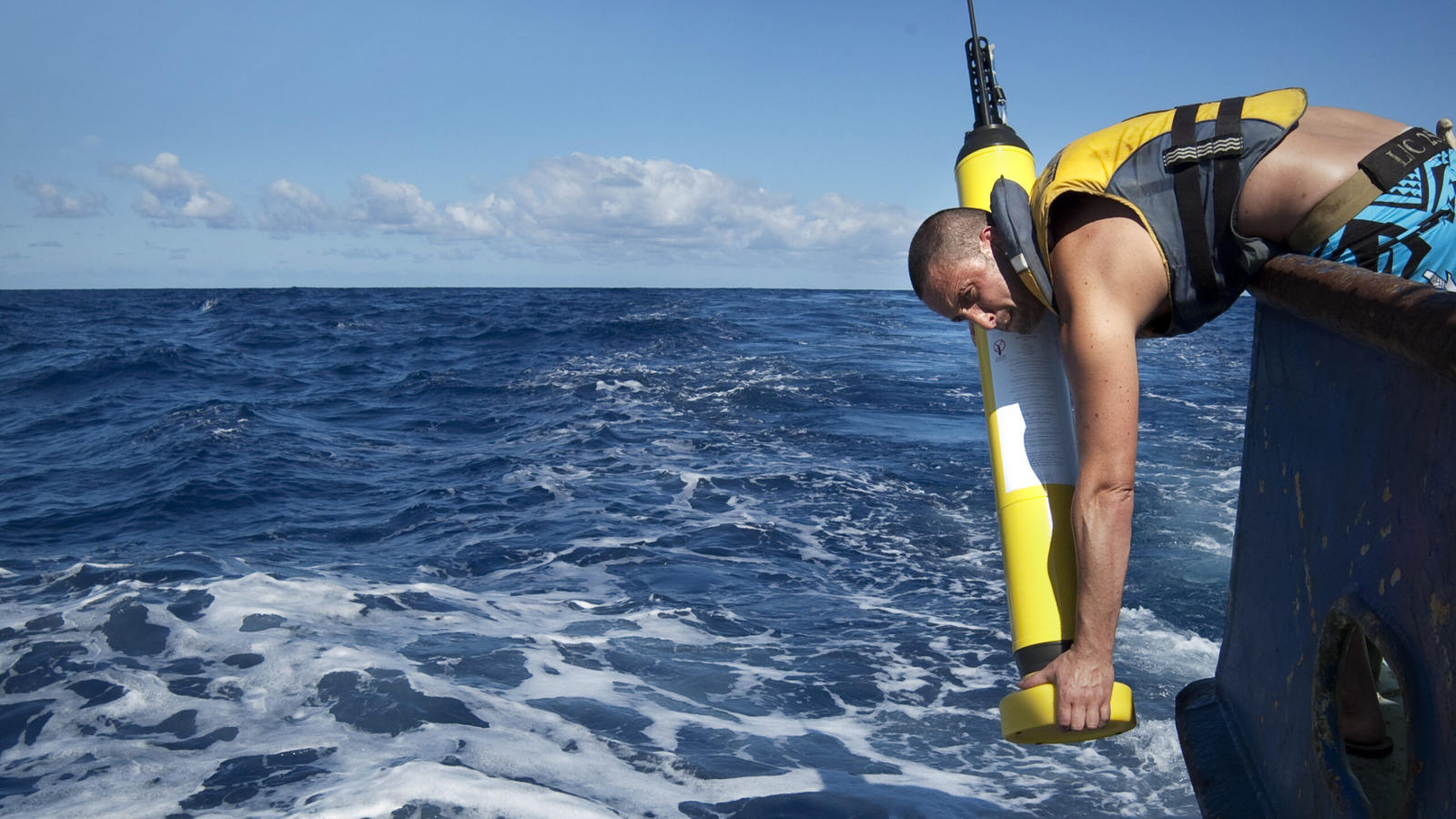
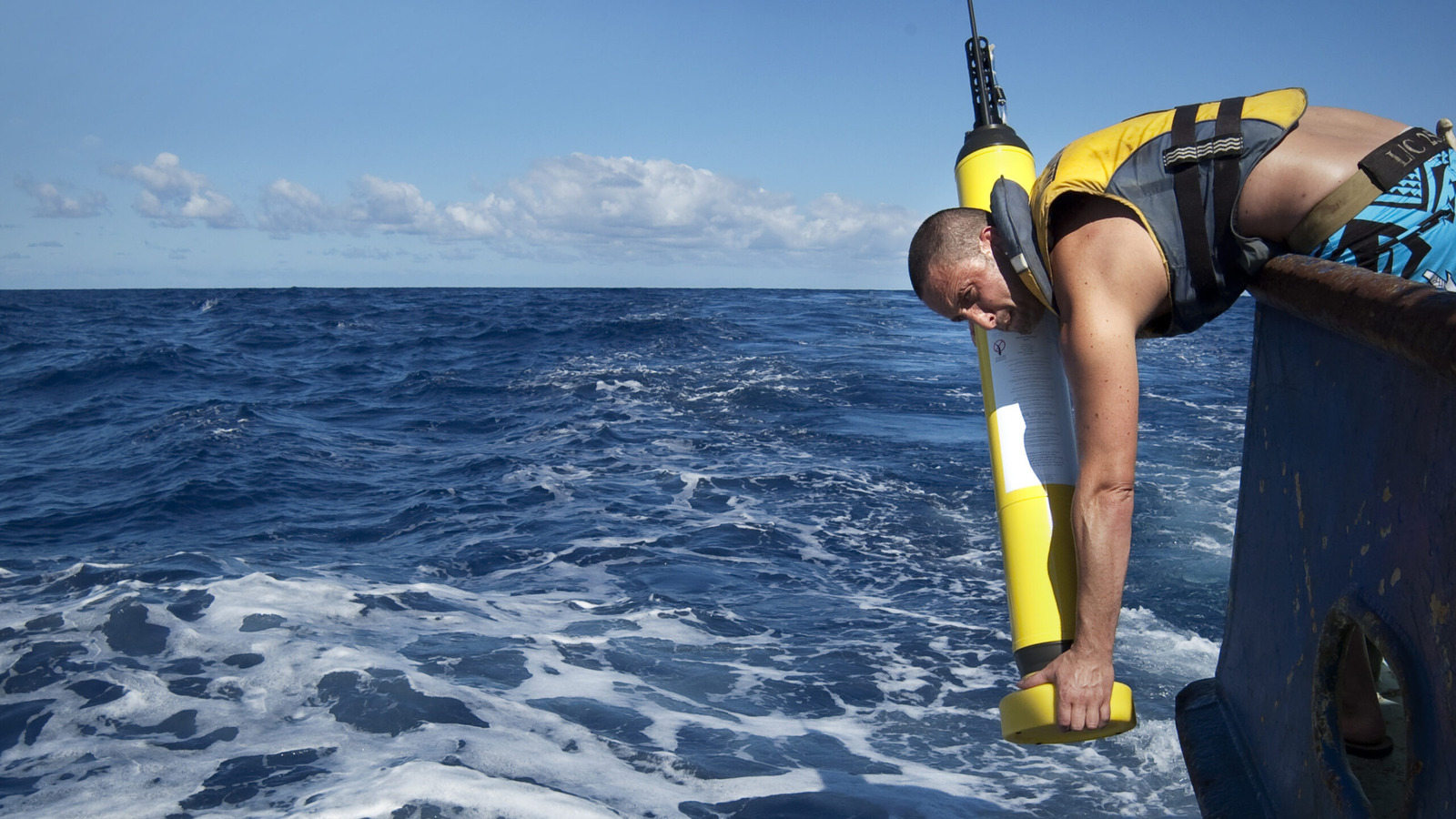
New ocean-sensing drones are being constructed to resist the deepest depths of the ocean.
Greater than 70 % of our planet is roofed by the ocean, however the overwhelming majority of it stays unexplored — an more and more pressing blind spot as local weather change raises water temperatures and. Autonomous underwater drone floats might quickly shut that hole, with a rising fleet set to cowl greater than 98 % of ocean quantity by 2028.
Exploring new depths
In the present day, the overwhelming majority of ocean information is generated by members of the Argo Program — a world collaboration launched in 1999 that deploys 4,000 data-collection floats worldwide. The vast majority of Argo drones (just like the one pictured above) descend between 2,000 and 4,000 meters into the ocean, however 10 % of ocean warming happens beneath these depths, marking a serious hole in information assortment.
This 12 months, Ifremer — the French state ocean company — reported its two Deep-6000 prototypes had accomplished 5 dives of 6,000 meters (practically 20,000 ft) between January 11 and February 2 of this 12 months, amassing essential information on the abyssal zone. These profitable missions make France the third nation on the earth, following China and the USA, to develop Argo floats able to reaching these depths.
Ifremer stated that by 2028, 30 extra deep-sea floats will be part of the prevailing Argo-led worldwide fleet of 4,000 units, permitting researchers to discover greater than 98 % of the ocean.
The US at the moment operates greater than 100 deep-sea floats and China operates greater than thirty.
How do the dives work?
Greater than 90 % of the ocean is taken into account deep ocean, reaching 200 meters (656 ft) deep or extra — and of your complete ocean, solely 5 % has been explored. The dearth of analysis on the deepest ocean areas — or abyssal zones — is basically as a result of technical constraints. At these depths, the ocean places an infinite quantity of strain on equipment — roughly one ambiance for each 10 meters of depth.Meaning at 6,000 meters, the strain is roughly 600 instances higher than that at sea degree.
“The primary problem was to design a system that might stand up to the pressures of the deep sea, be self-sufficient by way of power to stay operational for seven years, and hold prices underneath management,” Xavier André, head of profiler expertise improvement at Ifremer, stated in a press launch.
To accommodate for the large quantities of strain, Ifremer constructed the hulls of its Deep-6000 prototypes with composite supplies aside from pure titanium. At 88 kilos, the units weigh roughly twice as a lot as a typical Argo float, permitting it to raised stand up to the extraordinary strain.
The float missions for these Argo units run on ten-day cycles: the float is dropped from a ship, descending to a “drift” depth the place it stays for 9 days, then additional descending to a “profile” depth for about three hours. The float then ascends again to the floor, the place it sends information it has collected to a satellite tv for pc. This course of is repeated till its battery dies — normally round 150 cycles over three to 5 years.
What info do the drones accumulate?
The floats accumulate info on water salinity, temperature, oxygen and strain to assist scientists at climate and local weather facilities higher perceive how the ocean is behaving as local weather change warms the waters. Argo information can be utilized to enhance forecasts of main local weather phenomena like monsoons, ocean warming, sea degree rise and ocean circulation. The 4,000 floats that exist globally produce greater than 100,000 temperature and salinity profiles per 12 months, and all Argo information is free on-line to entry and use.
Virginie Thierry, a bodily oceanographer at Ifremer, stated in a press launch that the brand new Deep-6000 floats will enable the French group to trace ocean warming throughout abyssal depths.
“We may even be capable to get hold of info on deep ocean circulation,” she stated, “which contributes to the storage of local weather indicators akin to warmth and carbon within the deep ocean, and refine ocean prediction fashions. Argo is an instance of actually exceptional worldwide cooperation, with greater than 60 nations contributing to it.”