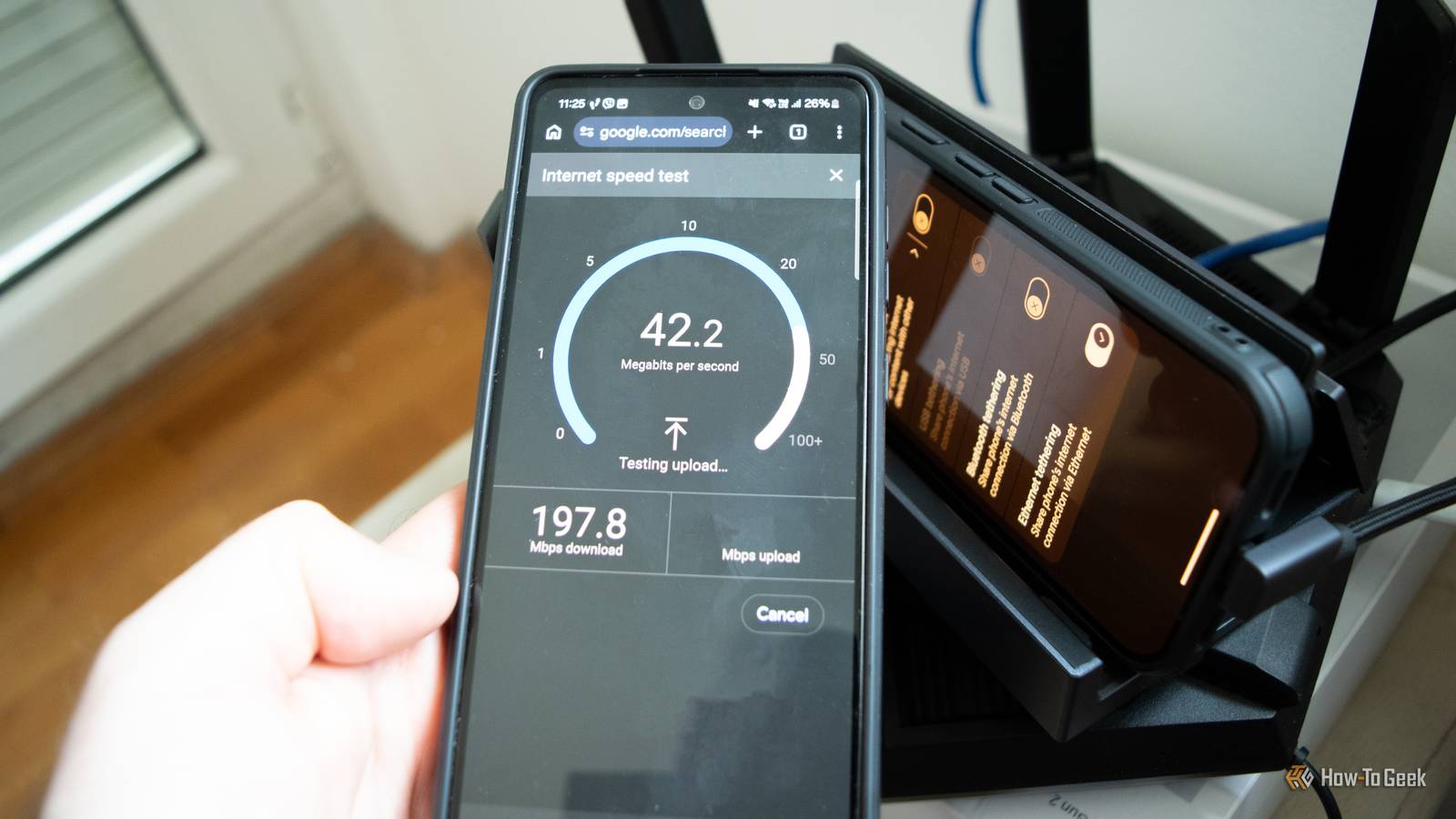
In the event you really feel like your web is taking part in up, what’s the very first thing you do? Lots of us attain for a similar device: a pace check. These issues catch extra than simply sluggish web; additionally they be aware your latency, and if there’s packet loss, you may see it as a result of the pace check will take ages to finish (or it will not full in any respect). And so long as it exhibits a quantity inside our expectations, we shrug and assume the Wi-Fi is simply having a nasty day.
A easy pace check, nevertheless, isn’t one thing anybody ought to be judging their complete community by. Even with a half-dead Ethernet cable, for instance, your pace check can nonetheless provide you with an excellent end result. In the event you truly wish to check your setup, a bandwidth check is the higher place to begin.
A pace check solely ever checks your web, not your cable
It faucets out the second you hit no matter your plan is promoting you
All a pace check does is measure the trail out of your gadget to a server on the web, and it is utterly capped by no matter web plan you’ve gotten. Ethernet cables, nevertheless, can transfer a lot sooner than most plans, so a pace check will doubtless by no means stress it.
In the event you do find yourself with a low quantity from a pace check, guessing the offender could be fairly tough. It might be your ISP, a VPN, a browser extension, a busy check server, congestion, an outdated router, or one thing else totally.
It is also value going round and checking your Ethernet cables, since you can be coping with one thing like a damaged locking clip, a pointy bend, or a chewed cable. You probably have pets, that may undoubtedly occur; I nonetheless keep in mind years in the past, when my (then a pet) canine chewed up my Ethernet cable in a reasonably hidden-away spot. It took me some time to note.
There are truthfully so many issues that may trigger a nasty pace check end result. It isn’t all the time your ISP (though in my case, it typically is, however I am unfortunate in terms of ISPs).
The sneaky half is how a nasty cable truly fails
Gigabit wants all 4 pairs, and dropping one will not kill the connection
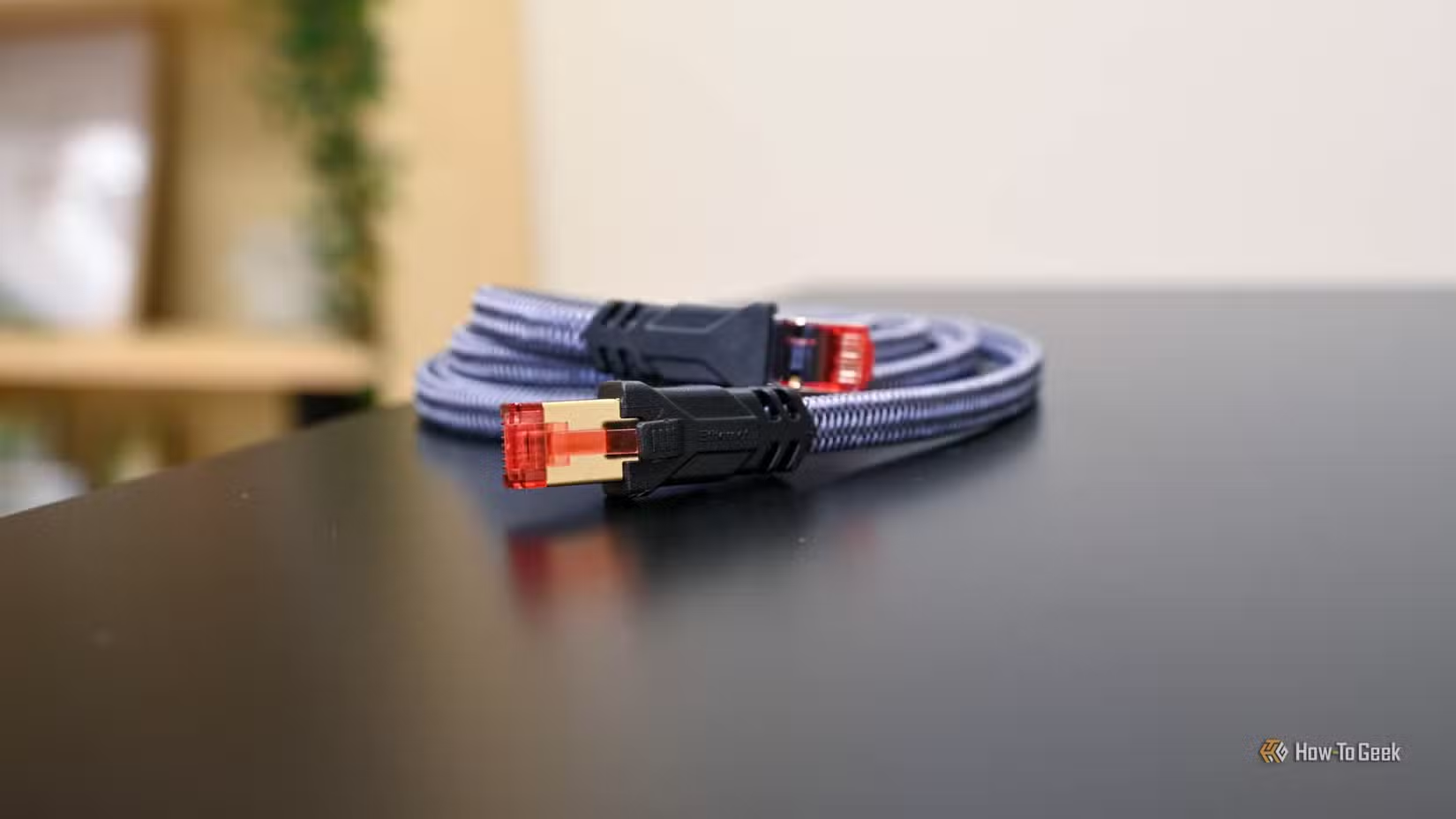
An Ethernet cable has eight wires inside, organized as 4 twisted pairs. Full gigabit (the 1000BASE-T commonplace) wants all 4 of these pairs in working order, whereas older 100Mbps Quick Ethernet solely wants two.
So, if one pair will get broken, your hyperlink can drop from 1Gbps right down to 100Mbps however maintain working all the identical. Nothing disconnects, nothing throws an error, and the connection merely renegotiates itself down to remain steady.
If issues go actually mistaken, your adapter may even negotiate itself right down to 2003-era speeds with out you noticing a factor.
The precise check: verify your hyperlink pace, then run iPerf3
One quantity exhibits you the ceiling, the opposite exhibits you what you are getting
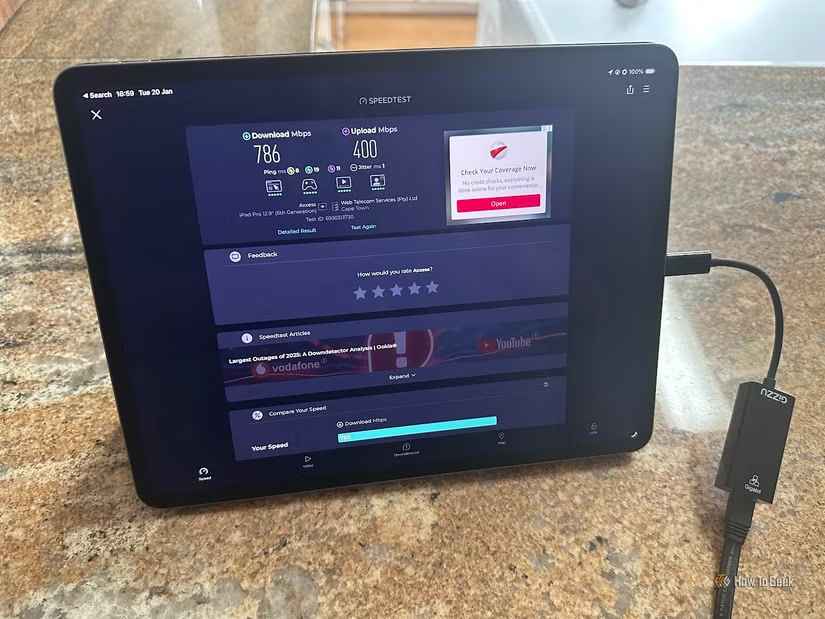
The very first thing to verify is your hyperlink pace, additionally referred to as the negotiated pace. On Home windows, head to Settings, then Community & web, then Ethernet, or simply run Get-NetAdapter in PowerShell. In case your PC has a gigabit port however the hyperlink solely exhibits 100Mbps, then the issue is someplace in your wiring quite than your web. (Doubtlessly. Perhaps. Community troubleshooting is such a problem, truthfully.)
Subsequent, check out this useful gizmo: iPerf3. I take advantage of it rather a lot. It is a free command-line utility that measures uncooked pace between two gadgets by yourself community, with the web utterly out of the image. As a substitute, it exhibits you the true ceiling of your cable, port, and community card.
Set up it on two gadgets (brew set up iperf3 on Mac, Scoop or winget on Home windows, apt on Linux). On one machine, run iperf3 -s to make it the server, then on the opposite, run iperf3 -c adopted by the primary machine’s IP handle.
A wholesome cable ought to provide you with round 900Mbps or extra, so if you happen to’re crawling at beneath 100Mbps as an alternative, you’ve gotten found a defective cable. Tack on -R to flip the course, -t 30 for an extended run, or -i 1 to catch intermittent drops, and keep watch over the “Retr” column, since a pile of retransmits normally means a flaky bodily hyperlink.
When the check lastly factors on the cable
Swap first, tester second, change third

So, if these checks provide you with dangerous outcomes, the repair is fairly simple.
First, confirm the outcomes by swapping in a brief, working cable, and run the check once more. If the numbers soar up, that cable is unquestionably the issue. It is the identical trick I take advantage of for a cable that may merely be too lengthy, the place the sign degrades simply sufficient to pressure those self same slowdowns.
An affordable cable tester (the $10 type) is an efficient subsequent step, because it immediately catches damaged wires, shorts, and miswires. Simply understand it will not flag subtler points like crosstalk, so a cable can technically “move” and nonetheless choke at gigabit.
As for replacements, Cat6 ought to be the default for something new, however there’s undoubtedly no must panic-buy Cat8 for a standard house. Actually, loads of the Cat5e cables you already personal are nonetheless completely fantastic for gigabit, so long as they’re in fine condition.
The pace check is not ineffective, it is simply answering a special query
A pace check tells you if you happen to’re getting the web speeds you are paying for, and that is one thing all of us must verify at one level or one other. Your hyperlink pace and an iPerf3 run, nevertheless, reply a totally totally different query: “Is my very own wiring quietly holding me again?” Nothing lasts perpetually, so sooner or later, these Ethernet cables would be the ones inflicting the issues.